Global dividends: A counterweight to the AI trade
As AI-driven mega-caps dominate market narratives, global dividends are charting a different path when investors need it most.
.jpg)
As AI-driven mega-caps dominate market narratives, global dividends are charting a different path when investors need it most.
The dominance of US mega‑cap technology stocks continues to shape global equity beta, leaving many portfolios heavily exposed to a narrow set of AI beneficiaries. Today, the ten largest AI‑linked names—almost all exceeding $1 trillion in market value—account for more than 35% of the S&P 500 and 25% of the FTSE All‑World1. This level of concentration can amplify market risk, valuation sensitivity and macro‑policy vulnerability.
Against this backdrop, value‑oriented strategies—particularly those designed to avoid value traps—offer an increasingly effective approach. These strategies have begun to diverge meaningfully from global beta, signalling an alternative return and risk profile at a time when macro uncertainty is on the rise.
Through 2025, value stocks showed clear signs of breaking away from broader market dynamics. This is illustrated by the sharp decline in correlations between the FTSE All‑World High Dividend Yield Index–which moved in lockstep with value–and its parent index, the FTSE All-World Index. Correlation levels fell from near‑perfect to 0.60 (as the chart below shows), meaning that only around 36% of the index’s volatility was attributable to beta alone.
This decoupling has coincided with a marked rise in economic and policy‑related uncertainty, as reflected in Economic Policy Uncertainty (EPU) readings. In this environment, the AI trade has proved susceptible to shocks, including supply‑chain disruption, semiconductor tensions and geopolitical risk. For example, despite posting strong earnings throughout 2025, the Nasdaq 1002 (+21% return in 2025) and S&P 500 (+17%) lagged both the FTSE All‑World (+23%) and FTSE All‑World High Dividend Yield Index (+26%)3.
Correlations fall as uncertainty rises
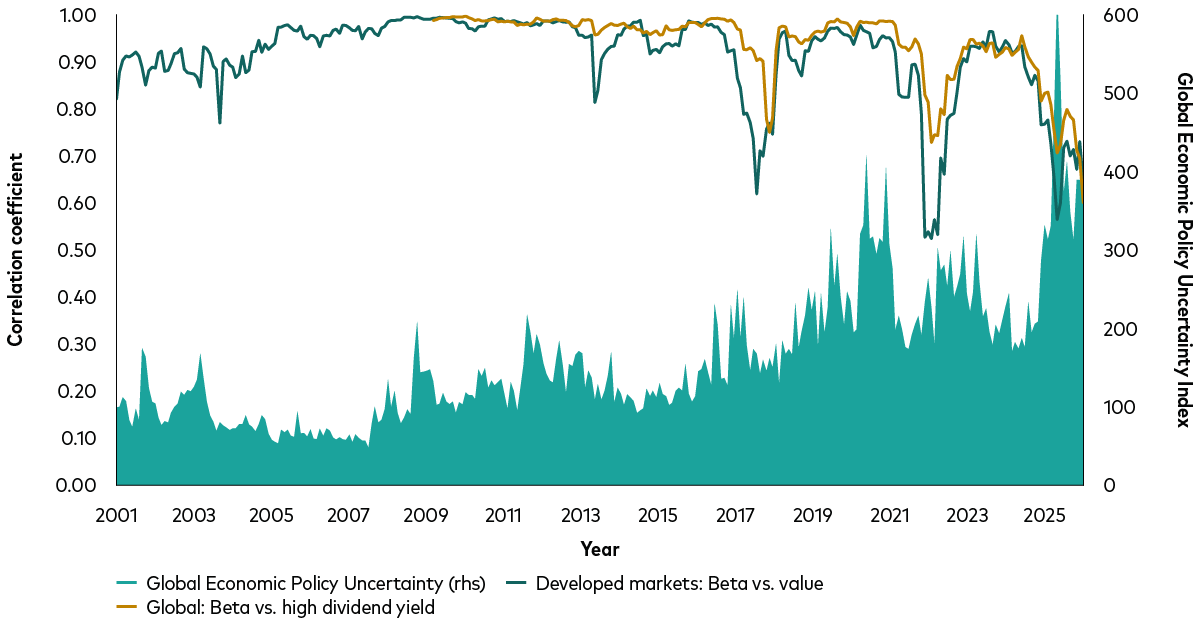
Source: FactSet. Data from 31 December 1997 to 31 December 2025. Global: beta versus high dividend yield is the correlation between FTSE All-World Index versus the FTSE All-World High Dividend Yield Index; developed markets: beta versus value is the correlation between MSCI World Index versus MSCI World Enhanced Value Index. Correlations based on monthly net total returns in USD. The EPU (Economic Policy Uncertainty) Index measures the frequency of newspaper articles mentioning terms related to economy, policy and uncertainty.

Outperformance relative to earnings expectations does not necessarily insulate high‑growth stocks—including AI hyperscalers—from cash flow stress when market narratives become more fragile.
For investors seeking to mitigate concentration risk and find an antidote to the AI trade, dividend‑oriented value exposures, such as the Vanguard FTSE All-World High Dividend Yield UCITS ETF (“the ETF”), present a viable alternative. The methodology behind this exposure avoids backward‑looking valuation anchors and instead emphasises forward‑looking payout durability.
The construction methodology of the ETF stands out for two key reasons:
1. Dividend‑per‑share estimates as a forward‑looking value metric
Broker dividend‑per‑share forecasts offer a transparent gauge of durable payouts. Unlike book value, they are less exposed to accounting distortions and closely aligned with shareholder distributions. We discuss this forward-looking approach further in our latest deep-dive analysis for portfolio constructors, Dividends unpacked.
2. Cap‑weighted selection to reduce value‑trap risk
By selecting the top 50% of dividend‑yielding stocks but weighting them by market cap rather than yield, the index tracked by the ETF tilts towards firms more capable of affording the dividend – not those whose yields could be inflated by depressed prices.
The most recent rebalance (September 2025) of the FTSE All-World High Dividend Yield Index reinforces this strength: the screen excluded all 10 of the previously mentioned AI-led names—avoiding their valuation and thematic risk—while retaining mature dividend payers across global sectors.
Sector composition and performance drivers
Financials, consumer staples and industrials remain dominant in the FTSE All-World High Dividend Yield Index’s top holdings and were major contributors to 2025 performance (as the chart below shows). The index’s diversified constituents result in significantly lower concentration than global beta. For example:
The absence of AI-associated exposure was a defining factor in the index’s differentiation last year – both in return profile and risk characteristics.
Top 10 stock contributors to 2025 index performance
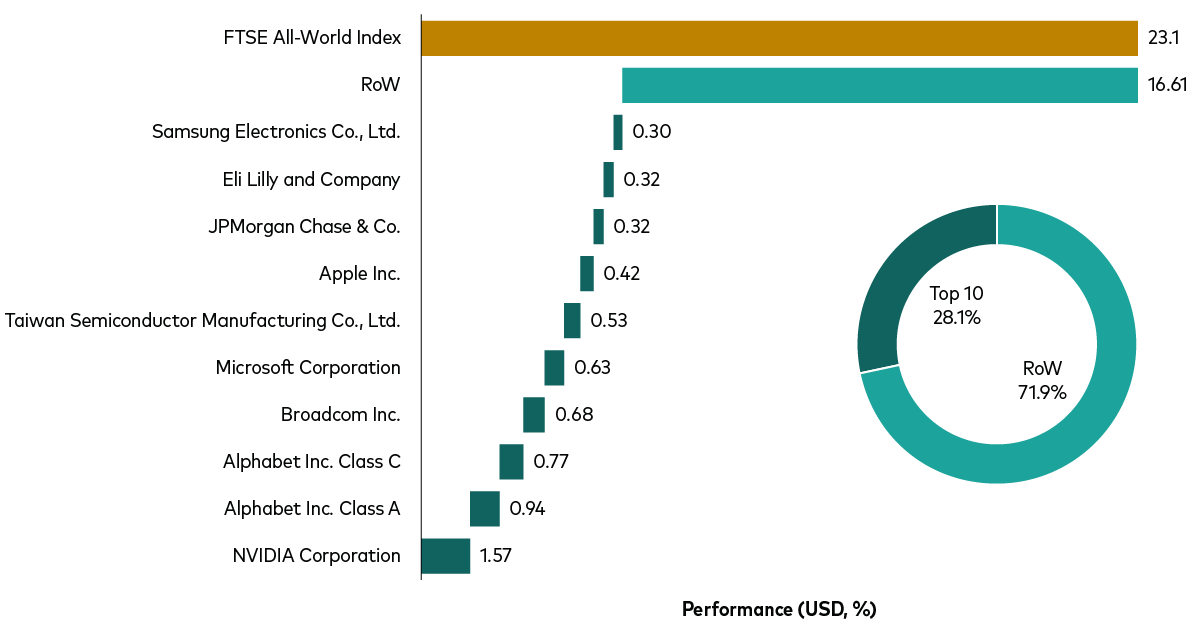
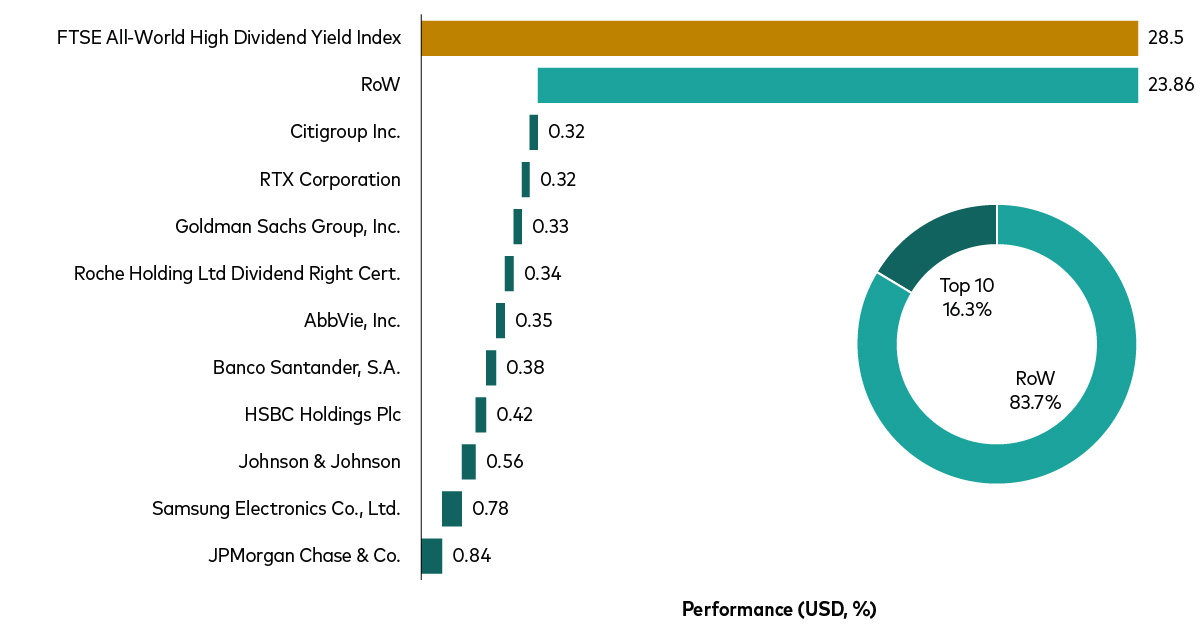
Past performance is not reliable indicator for future results.
Source: FactSet, Vanguard. Data from 31 December 2024 to 31 December 2025. Performance is based on gross total returns in USD. RoW = rest of the world. It is not possible to invest directly in an index.
The Vanguard FTSE All-World High Dividend Yield UCITS ETF can provide a compelling counterbalance to concerns about a market environment characterised by growing uncertainty and surging AI‑related capital expenditure, as it:
For investors questioning the durability of the AI‑led equity regime, global dividends offer not just income, but a structural hedge against thematic and concentration risk.
To learn more about global high-dividend exposure and how the FTSE All-World High Dividend Yield Index stands apart from its peers, read our deep dive, Dividends unpacked: Investment case, index selection and implementation.
1 These companies are NVIDIA, Apple, Amazon, Microsoft, Google, Meta Platforms, Tesla, AMD, Broadcom, Palantir. Source: Bloomberg, as at 31 December 2025.
2 The Nasdaq 100 is a stock market index that tracks the 100 largest non‑financial companies listed on the Nasdaq exchange, with weightings based on market capitalisation.
3 Source: Bloomberg, as at 31 December 2025. Past performance is not a reliable indicator of future returns. It is not possible to invest directly in an index. Returns are net total returns in USD terms.
4 Source: Bloomberg, Vanguard. Data from 31 December 2000 to 30 November 2025. See chart above showing uncertainty based on Economic Policy Uncertainty Index.
Investment risk information
The value of investments, and the income from them, may fall or rise and investors may get back less than they invested.
Past performance is not a reliable indicator of future results. The performance data does not take account of the commissions and costs incurred in the issue and redemption of shares.
Performance figures shown may be calculated in a currency that differs from the currency of the share class that you are invested in. As a result, returns may decrease or increase due to currency fluctuations.
Investments in smaller companies may be more volatile than investments in well-established blue chip companies.
ETF shares can be bought or sold only through a broker. Investing in ETFs entails stockbroker commission and a bid-offer spread which should be considered fully before investing.
The Funds may use derivatives in order to reduce risk or cost and/or generate extra income or growth. The use of derivatives could increase or reduce exposure to underlying assets and result in greater fluctuations of the Fund's net asset value. A derivative is a financial contract whose value is based on the value of a financial asset (such as a share, bond, or currency) or a market index.
Some funds invest in securities which are denominated in different currencies. Movements in currency exchange rates can affect the return of investments.
For further information on risks please see the “Risk Factors” section of the prospectus.
Important information
This is a marketing communication.
For professional investors only (as defined under the MiFID II Directive) investing for their own account (including management companies (fund of funds) and professional clients investing on behalf of their discretionary clients). In Switzerland for professional investors only. Not to be distributed to the public.
For further information on the fund's investment policies and risks, please refer to the prospectus of the UCITS and to the KIID (for UK, Channel Islands, Isle of Man investors) and to the KID (for European investors) before making any final investment decisions. The KIID and KID for this fund are available in local languages, alongside the prospectus, which is available in English only, via Vanguard’s website.
The information contained herein is not to be regarded as an offer to buy or sell or the solicitation of any offer to buy or sell securities in any jurisdiction where such an offer or solicitation is against the law, or to anyone to whom it is unlawful to make such an offer or solicitation, or if the person making the offer or solicitation is not qualified to do so. The information is general in nature and does not constitute legal, tax, or investment advice. Potential investors are urged to consult their professional advisers on the implications of making an investment in, holding or disposing of shares and /or units of, and the receipt of distribution from any investment.
For Swiss professional investors: Potential investors will not benefit from the protection of the FinSA on assessing appropriateness and suitability.
Vanguard Funds plc has been authorised by the Central Bank of Ireland as a UCITS and has been registered for public distribution in certain EEA countries and the UK. Prospective investors are referred to the Funds' prospectus for further information. Prospective investors are also urged to consult their own professional advisers on the implications of making an investment in, and holding or disposing shares of the Funds and the receipt of distributions with respect to such shares under the law of the countries in which they are liable to taxation.
The Manager of Vanguard Funds plc is Vanguard Group (Ireland) Limited. Vanguard Asset Management, Limited is a distributor for Vanguard Funds plc.
For Swiss professional investors: The Manager of Vanguard Funds plc is Vanguard Group (Ireland) Limited. Vanguard Investments Switzerland GmbH is a financial services provider, providing services in the form of purchase and sales according to Art. 3 (c)(1) FinSA . Vanguard Investments Switzerland GmbH will not perform any appropriateness or suitability assessment. Furthermore, Vanguard Investments Switzerland GmbH does not provide any services in the form of advice. Vanguard Funds plc has been authorised by the Central Bank of Ireland as a UCITS. Prospective investors are referred to the Funds' prospectus for further information. Prospective investors are also urged to consult their own professional advisors on the implications of making an investment in, and holding or disposing shares of the Funds and the receipt of distributions with respect to such shares under the law of the countries in which they are liable to taxation.
For Swiss professional investors: Vanguard Funds plc has been approved for offer in Switzerland by the Swiss Financial Market Supervisory Authority. The information provided herein does not constitute an offer of Vanguard Funds plc in Switzerland pursuant to FinSA and its implementing ordinance. This is solely an advertisement pursuant to FinSA and its implementing ordinance for Vanguard Funds plc. The Representative and the Paying Agent in Switzerland is BNP Paribas Securities Services, Paris, succursale de Zurich, Selnaustrasse 16, 8002 Zurich. Copies of the Articles of Incorporation, KID, Prospectus, Declaration of Trust, By-Laws, Annual Report and Semiannual Report for these funds can be obtained free of charge from the Swiss Representative or from Vanguard Investments Switzerland GmbH.
The Manager of the Ireland domiciled funds may determine to terminate any arrangements made for marketing the shares in one or more jurisdictions in accordance with the UCITS Directive, as may be amended from time-to-time.
The Indicative Net Asset Value (“iNAV”) for Vanguard’s ETFs is published on Bloomberg or Reuters. Refer to the Portfolio Holdings Policy.
For investors in Ireland domiciled funds, a summary of investor rights is available in English, German, French, Spanish, Dutch and Italian.
London Stock Exchange Group companies include FTSE International Limited ("FTSE"), Frank Russell Company ("Russell"), MTS Next Limited ("MTS"), and FTSE TMX Global Debt Capital Markets Inc. ("FTSE TMX"). All rights reserved. "FTSE®", "Russell®", "MTS®", "FTSE TMX®" and "FTSE Russell" and other service marks and trademarks related to the FTSE or Russell indexes are trademarks of the London Stock Exchange Group companies and are used by FTSE, MTS, FTSE TMX and Russell under licence. All information is provided for information purposes only. No responsibility or liability can be accepted by the London Stock Exchange Group companies nor its licensors for any errors or for any loss from use of this publication. Neither the London Stock Exchange Group companies nor any of its licensors make any claim, prediction, warranty or representation whatsoever, expressly or impliedly, either as to the results to be obtained from the use of the FTSE or Russell indexes or the fitness or suitability of the indexes for any particular purpose to which they might be put.
For Dutch investors only: The fund(s) referred to herein are listed in the AFM register as defined in section 1:107 Dutch Financial Supervision Act (Wet op het financieel toezicht).For details of the Risk indicator for each fund listed, please see the fact sheet(s).
Issued in EEA by Vanguard Group (Ireland) Limited which is regulated in Ireland by the Central Bank of Ireland.
Issued in Switzerland by Vanguard Investments Switzerland GmbH.
Issued by Vanguard Asset Management, Limited which is authorised and regulated in the UK by the Financial Conduct Authority.
© 2026 Vanguard Group (Ireland) Limited. All rights reserved.
© 2026 Vanguard Investments Switzerland GmbH. All rights reserved.
© 2026 Vanguard Asset Management, Limited. All rights reserved.