Tilting to fixed income amid AI-driven market exuberance
Amid AI exuberance, discover why fixed income matters. Our Time Varying Asset Allocation aims to balance portfolio resilience with long term opportunity.

Amid AI exuberance, discover why fixed income matters. Our Time Varying Asset Allocation aims to balance portfolio resilience with long term opportunity.
With today’s investment climate of high interest rates and elevated equity valuations, understanding how to allocate across asset classes is essential. To help portfolio constructors navigate this environment, we use our valuation aware, time varying asset allocation (TVAA) approach. TVAA is a systematic framework that adjusts allocations based on market conditions. One application of TVAA is the aim of earning higher risk-adjusted returns relative to a strategic benchmark, which can be appropriate for investors willing to take on active risk in the form of “model forecast risk”. It is not designed to predict the next market move, but to tap an additional source of potential outperformance over the medium term. The portfolio shown in this article is illustrative, designed to demonstrate such a TVAA portfolio given the current market backdrop.
Elevated interest rates combined with still high starting equity valuations point to a slimmer equity risk premium than many investors have grown used to. And while the market remains gripped by the promise of AI, history shows that major technology cycles often bring spurts of exuberance followed by slower, uneven payoffs. Against this backdrop, our valuation aware, TVAA approach resists the temptation to extrapolate today’s enthusiasm directly into tomorrow’s earnings. Instead, it aims to position portfolios for a range of outcomes, balancing long term opportunity with near term valuation discipline.
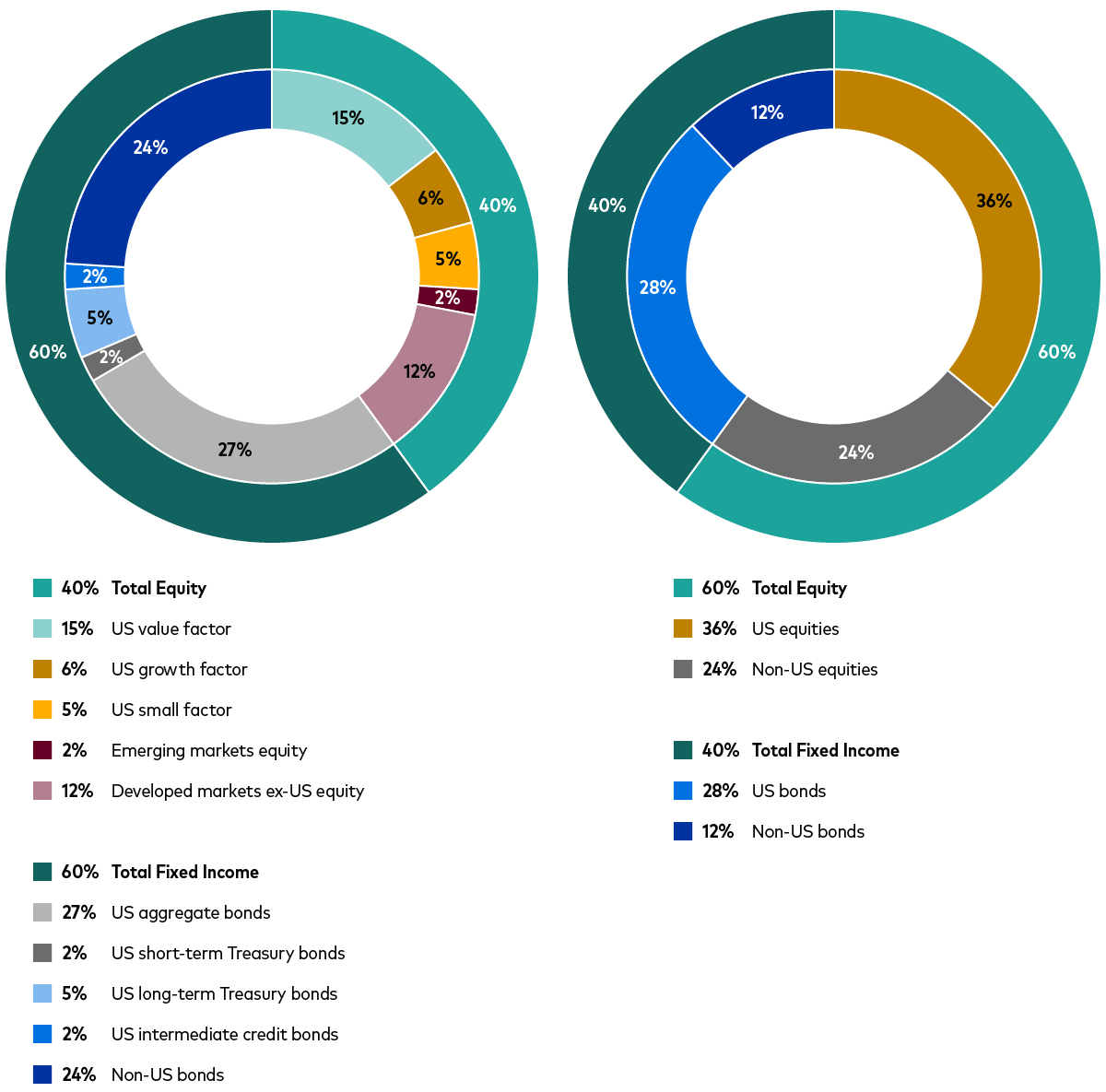
We cut equity exposure in our TVAA model by 20% relative to a 60/40 benchmark, holding 40% in equities and 60% in bonds. The portfolio is designed for investors willing to take model forecast risk in exchange for a more balanced path through an AI charged cycle1.
Within equities, we prefer breadth over concentration. The portfolio keeps a clear US anchor but expresses it through diversified building blocks: the US value factor (4.6% allocation), US growth factor (6.2%) and US small cap factor (5.2%)1. Alongside that, the portfolio has an allocation to developed market ex US equity (12.0%) and a smaller holding in emerging market equity (2.0%). This reflects our view that AI related gains may spread beyond today’s headline winners and that the long term benefits of new technology tend to diffuse across regions and sectors rather than reward only the early champions. We want exposure to that broadening, not a bet on a single market or theme.
Economic transformations often come with sharp rotations in equity market leadership. High quality bonds can help investors stay the course through those shifts. With credit spreads still tight, we prefer to tilt away from explicit credit risk. Instead, we anchor the portfolio to US aggregate bonds (26.6%) and hedged non-US bonds (24.0%), complemented by US Treasuries across the curve (2.0% short term and 5.4% long term) and a small allocation to US intermediate-maturity credit (2.0%). This provides investors income, diversification and a cleaner ballast should equity optimism ebb.
Our 10 year projections show a slightly higher expected return than the benchmark (5.7% versus 5.3% annualised) and meaningfully lower expected volatility (6.9% versus 9.3%). That comes with active risk: expected tracking error is around 3.89%, and the probability of underperforming the benchmark in any given year is approximately 45%.
The aim is simple: to balance near term macro momentum, long term valuation discipline and the lessons from past technology cycles. We want the portfolio to take part in the gains that disruptive innovation can bring while maintaining the resilience needed for the phases when sentiment outruns reality.
TVAA Benchmark
Portfolio characteristics2
|
TVAA |
Benchmark |
10-year expected annualised return |
5.7% |
5.3% |
10-year expected annualised volatility |
6.9% |
9.3% |
Expected Sharpe ratio |
0.29 |
0.18 |
Expected maximum drawdown |
-4.8% |
-9.3% |
Tracking error compared with the benchmark |
3.9% |
n/a |
Probability of underperforming the benchmark |
45.3% |
n/a |
Source: Vanguard analysis, January 2025.
Asset class return expectations
Equity return expectations: distribution of annualised expected returns over the next 10 years in US dollar terms.
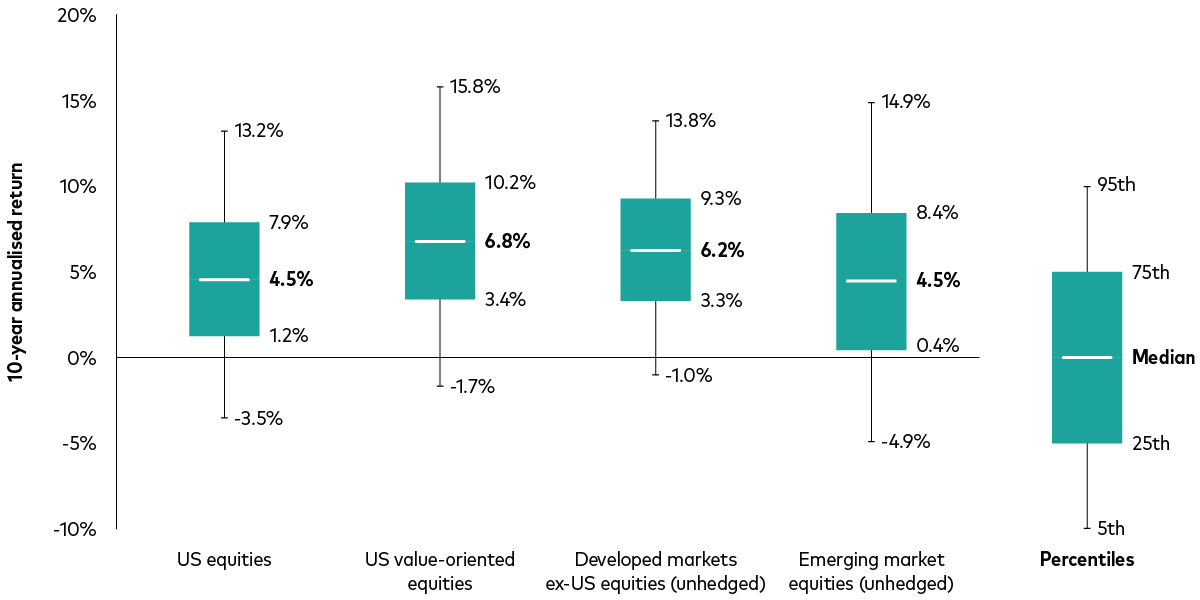
Any projections should be regarded as hypothetical in nature and do not reflect or guarantee future results.
Notes: The forecast corresponds to the distribution of 10,000 Vanguard Capital Markets Model (VCMM) simulations for 10-year annualised nominal returns in USD for assets highlighted here. Asset-class returns do not take into account management fees and expenses, nor do they reflect the effect of taxes. Returns do reflect the reinvestment of income and capital gains. Indices are unmanaged; therefore, direct investment is not possible.
Source: Vanguard calculations as at 31 October 2025.
IMPORTANT: The projections and other information generated by the VCMM regarding the likelihood of various investment outcomes are hypothetical in nature, do not reflect actual investment results and are not guarantees of future results. Distribution of return outcomes from the VCMM are derived from 10,000 simulations for each modelled asset class. Simulations are as at 31 October 2025. Results from the model may vary with each use and over time.
Bond return expectations: distribution of annualised expected returns over the next 10 years in US dollar terms.
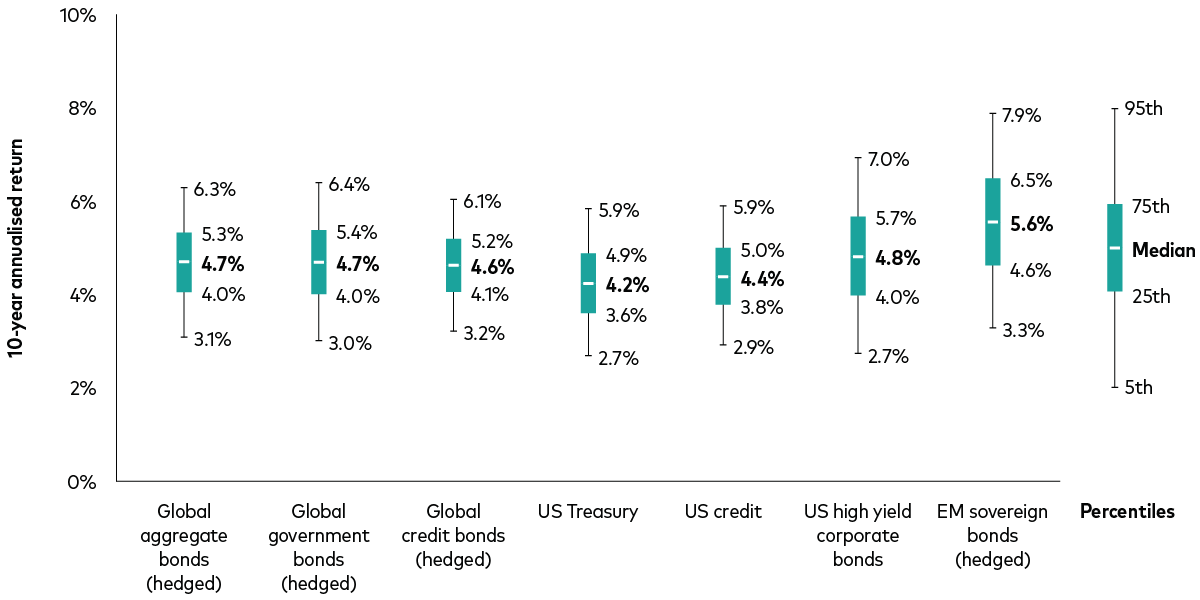
Any projections should be regarded as hypothetical in nature and do not reflect or guarantee future results.
Notes: The forecast corresponds to the distribution of 10,000 VCMM simulations for 10-year annualised nominal returns in USD for assets highlighted here. Asset-class returns do not take into account management fees and expenses, nor do they reflect the effect of taxes. Returns do reflect the reinvestment of income and capital gains. Indices are unmanaged; therefore, direct investment is not possible.
Sources: Vanguard calculations as at 31 October 2025.
IMPORTANT: The projections and other information generated by the VCMM regarding the likelihood of various investment outcomes are hypothetical in nature, do not reflect actual investment results and are not guarantees of future results. Distribution of return outcomes from the VCMM are derived from 10,000 simulations for each modelled asset class. Simulations are as at 31 October 2025. Results from the model may vary with each use and over time.
Overall, the portfolio positioning reflects a disciplined approach to today’s valuation landscape and market dynamics. Underlying these decisions is Vanguard’s proprietary valuation-aware time-varying asset allocation. TVAA is for investors who are comfortable with model forecast risk, which is a type of active risk. It can serve as a useful guide for professional asset allocators to dynamically adjust a portfolio’s positioning based on medium-term forecasts to enhance returns or manage risks, or both, depending on the market environment.
For an in-depth look at what Vanguard expects for the economy and markets in 2026, read AI exuberance: Economic upside, stock market downside.
1 Any projections should be regarded as hypothetical in nature and do not reflect or guarantee future results. Capital at risk. Time‑varying portfolio allocations were determined by the Vanguard Asset Allocation Model (VAAM). Equity assets under consideration were US value factor, US growth factor, US small factor, developed markets ex‑US, and emerging markets. Fixed income assets under consideration were US aggregate bonds, US intermediate‑term credit, US short‑term Treasuries, US long‑term Treasuries, and hedged non-US bonds. Vanguard Capital Markets Model (VCMM) 10‑year projections as of 31 October 2025 were used.
Source: Vanguard analysis, January 2025
2 Notes: Vanguard calculations are based on portfolios optimised by the VAAM, using return projections from the VCMM. Sharpe ratio is a measure of return above the risk-free rate that adjusts for volatility. A higher Sharpe ratio indicates a higher expected risk-adjusted return. Expected maximum drawdown is the median peak-to-trough drop in the portfolio’s value in 10,000 VCMM simulations. The probability of underperforming the benchmark is in any given year.
Source: Vanguard calculations, as of 31 October 2025.
Explore upcoming events and our on-demand library. All CPD accredited.
IMPORTANT: The projections or other information generated by the Vanguard Capital Markets Model® regarding the likelihood of various investment outcomes are hypothetical in nature, do not reflect actual investment results, and are not guarantees of future results. VCMM results will vary with each use and over time. The VCMM projections are based on a statistical analysis of historical data. Future returns may behave differently from the historical patterns captured in the VCMM. More important, the VCMM may be underestimating extreme negative scenarios unobserved in the historical period on which the model estimation is based.
The Vanguard Capital Markets Model® is a proprietary financial simulation tool developed and maintained by Vanguard’s primary investment research and advice teams. The model forecasts distributions of future returns for a wide array of broad asset classes. Those asset classes include US and international equity markets, several maturities of the U.S. Treasury and corporate fixed income markets, international fixed income markets, US money markets, commodities, and certain alternative investment strategies. The theoretical and empirical foundation for the Vanguard Capital Markets Model is that the returns of various asset classes reflect the compensation investors require for bearing different types of systematic risk (beta). At the core of the model are estimates of the dynamic statistical relationship between risk factors and asset returns, obtained from statistical analysis based on available monthly financial and economic data from as early as 1960. Using a system of estimated equations, the model then applies a Monte Carlo simulation method to project the estimated interrelationships among risk factors and asset classes as well as uncertainty and randomness over time. The model generates a large set of simulated outcomes for each asset class over several time horizons. Forecasts are obtained by computing measures of central tendency in these simulations. Results produced by the tool will vary with each use and over time.
The primary value of the VCMM is in its application to analysing potential client portfolios. VCMM asset-class forecasts—comprising distributions of expected returns, volatilities, and correlations—are key to the evaluation of potential downside risks, various risk–return trade-offs, and the diversification benefits of various asset classes. Although central tendencies are generated in any return distribution, Vanguard stresses that focusing on the full range of potential outcomes for the assets considered, such as the data presented in this paper, is the most effective way to use VCMM output.
The VCMM seeks to represent the uncertainty in the forecast by generating a wide range of potential outcomes. It is important to recognise that the VCMM does not impose “normality” on the return distributions, but rather is influenced by the so-called fat tails and skewness in the empirical distribution of modelled asset-class returns. Within the range of outcomes, individual experiences can be quite different, underscoring the varied nature of potential future paths. Indeed, this is a key reason why we approach asset-return outlooks in a distributional framework.
Investment risk information
The value of investments, and the income from them, may fall or rise and investors may get back less than they invested.
Any projections should be regarded as hypothetical in nature and do not reflect or guarantee future results.
Important information
This is a marketing communication. This is directed at professional investors and should not be distributed to, or relied upon by retail investors.
The information contained herein is not to be regarded as an offer to buy or sell or the solicitation of any offer to buy or sell securities in any jurisdiction where such an offer or solicitation is against the law, or to anyone to whom it is unlawful to make such an offer or solicitation, or if the person making the offer or solicitation is not qualified to do so. The information does not constitute legal, tax, or investment advice. You must not, therefore, rely on it when making any investment decisions
The information contained herein is for educational purposes only and is not a recommendation or solicitation to buy or sell investments.
Issued by Vanguard Investments Switzerland GmbH.
© 2026 Vanguard Investments Switzerland GmbH. All rights reserved.