Valuations outlook: AI and higher rates shape the risks and opportunities
Strong equity performance and AI led gains have lifted valuations – we outline the risks and opportunities for stock and bond sub-asset classes.

Strong equity performance and AI led gains have lifted valuations – we outline the risks and opportunities for stock and bond sub-asset classes.
The global economy has entered 2026 shaped by an unusual mix of cyclical policy shifts and long‑term structural forces. At the centre is AI‑driven capital expenditure, now the dominant contributor to US growth and a key differentiator across regions. The US is projected to grow 2.25%, powered by strong investment and resilient consumer demand, while economic growth in the euro area and the UK remains more subdued, constrained by lower AI‑related spending.
Despite the optimism attached to AI, the investment cycle remains in its early stages - only 30–40% as large as historical build‑outs1 - leaving room for both productivity upside and emerging concentration risks as a handful of technology firms dominate spending2.
These cross‑currents shape the valuation environment investors face today: elevated equity prices leaning heavily on strong earnings assumptions, and fixed income markets benefitting from structurally higher neutral interest rates.
Few questions loom larger over markets than whether current equity valuations—especially in the US—are justified. US equity valuations are historically elevated. The cyclically adjusted price/earnings (CAPE) ratio sits between 35 and 40, a level surpassed only during the dot‑com bubble.
The rise in US valuations has happened with an increase in market expectations for earnings growth, now in double digits at 10-15%. If companies deliver such profit growth, and do so consistently over time, higher valuations than in the past could be justified.
But this is where the tension lies. The US mega‑cap leaders have strong balance sheets and robust free cash flow, and they stand to benefit disproportionately from AI‑related productivity gains. Yet markets are priced for perfection, as little margin for error remains. Three key risks could disrupt the current valuation regime:
Our scenario framework emphasises the dispersion of outcomes. The probability‑weighted central case for US equities points to 4–5% annualised returns (in USD, over the next decade), well below recent experience. This is the result of robust earnings growth, in line with long-run trends of 6-8%, but valuations moderating and weighing on prices.
In contrast, value‑oriented equities and developed markets outside the US appear more attractively priced. With the strong 2025 outperformance of European and emerging market equities, in particular, valuations are no longer cheap, but are still less stretched than for the broad US market. As such, our more attractive return outlook hinges less on valuation upside than on an improved earnings outlook and dividend yields, which are a more important return driver for developed markets outside the US.
2025 was a strong year for equities – but valuations have become more stretched
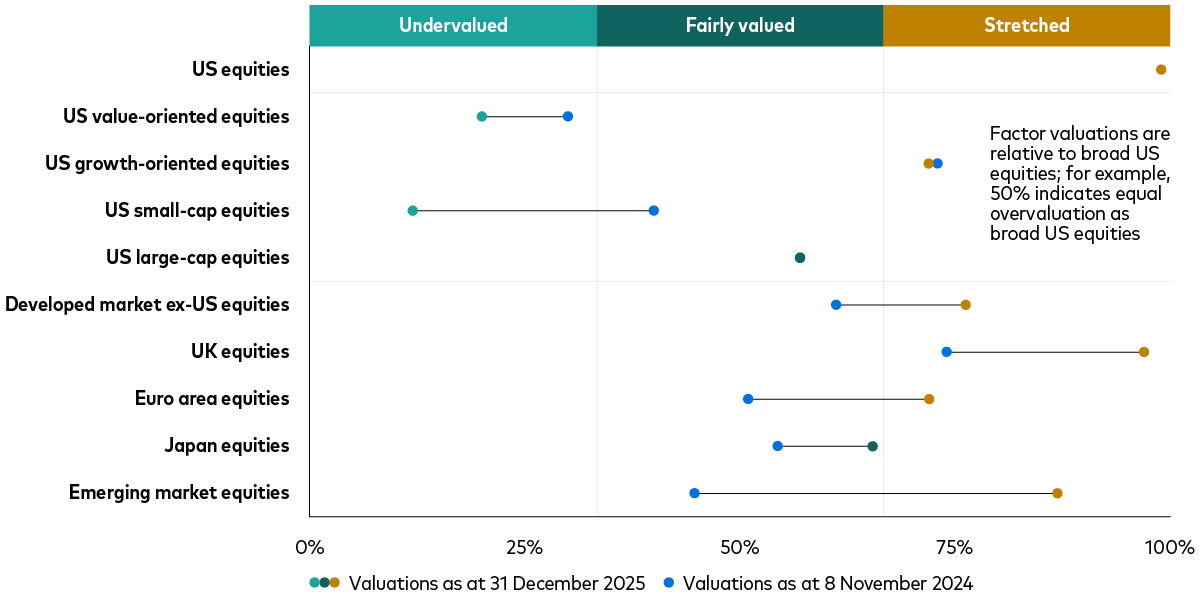
Notes: The US, UK, euro area and Japan equity valuation measures are the current cyclically adjusted price/earnings ratio (CAPE) percentile relative to our fair-value CAPE estimates for the MSCI US Broad Market Index, the MSCI UK Index, the MSCI EMU Index and the MSCI Japan Index. The developed ex-US equity valuation measure is the market-capitalisation-weighted CAPE percentiles relative to our fair-value CAPE estimate for the MSCI EMU, MSCI UK, MSCI Japan, MSCI Canada and the MSCI Australia valuation measure. The emerging market valuation measure is the price-to-trailing three-year average earnings ratio percentile to our fair-value estimate for the MSCI Emerging Markets Index. US growth, value, and small-cap valuation measures are all based on the percentile rank based on our fair-value model relative to the market. The US large-cap valuation measure is a composite valuation measure of the style factor to US relative valuations and the current US CAPE percentile relative to its fair-value CAPE. The valuation percentiles are as at 31 December 2025 and 8 November 2024.
Sources: Vanguard calculations, based on data from Refinitiv, as at 31 December 2025.
In contrast to equities, high-quality fixed income markets are in a more favourable valuation environment. Vanguard’s research highlights that high quality bonds offer compelling real returns, supported by a structural rise in neutral interest rates.
Estimates for neutral rates globally have drifted higher since 2019, with the US now around 3–4% and the euro area around 2%3. These higher equilibrium yields underpin the expectation of stronger income generation across government and high quality corporate bonds.
From a valuation standpoint, government bond markets—particularly in Europe—look relatively attractive. For US dollar investors, expected median returns across fixed income categories sit around 4–5.5%4, matching or even exceeding the central forecast for US equities. The traditional equity risk premium is compressed: US equities and global government bonds both exhibit similar expected returns.
Credit markets, especially in the US, look less compelling as spreads remain historically tight, leaving limited compensation for credit risk. While a favourable macroeconomic environment could keep spreads at these levels in the near term, the risk profile displays increasing and asymmetric downside risk.
In this context, fixed income markets offer an effective combination for portfolios, namely income and diversification. High-quality bonds can help investors to stay the course and remain invested through economic transformation with the build-out of AI.
Relative bond market valuations: Pockets of opportunity
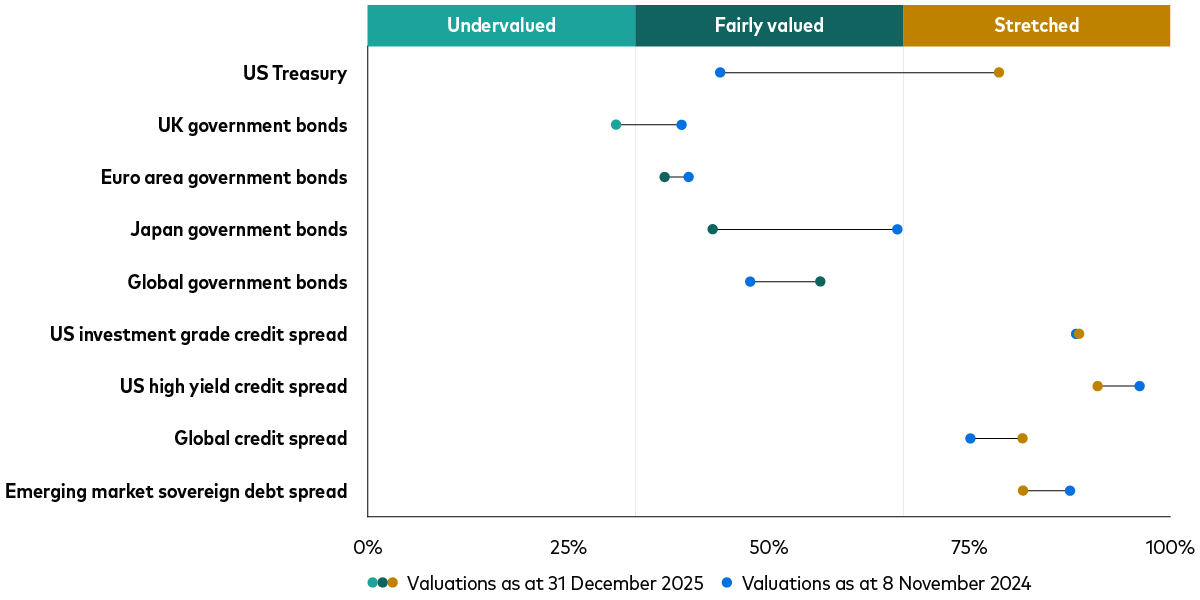
Notes: Government bond valuation percentiles are based on current yields relative to the VCMM simulation of equilibrium yields. Credit spread valuation measures are based on current spreads relative to the VCMM simulation of equilibrium spreads. Global bond valuation measures are the market-capitalisation-weighted average of the US, euro area, UK, Japan, Canada and Australia bond valuation measures. The valuation percentiles are as at 31 December 2025 and 8 November 2024.
Sources: Vanguard calculations, based on data from Refinitiv, as at 31 December 2025.
To learn more about how we view the investment landscape in 2026, please read the Vanguard economic and market outlook.
1 For example, the build-outs for railroads or the internet boom. For further discussion, see the Vanguard economic and market outlook for 2026.
2 Source: Vanguard economic and market outlook, December 2025.
3 Source: Vanguard economic and market outlook, December 2025.
4 Source: Vanguard, as at 31 October 2025.
IMPORTANT: The projections or other information generated by the Vanguard Capital Markets Model® regarding the likelihood of various investment outcomes are hypothetical in nature, do not reflect actual investment results, and are not guarantees of future results. VCMM results will vary with each use and over time. The VCMM projections are based on a statistical analysis of historical data. Future returns may behave differently from the historical patterns captured in the VCMM. More important, the VCMM may be underestimating extreme negative scenarios unobserved in the historical period on which the model estimation is based.
The Vanguard Capital Markets Model® is a proprietary financial simulation tool developed and maintained by Vanguard’s primary investment research and advice teams. The model forecasts distributions of future returns for a wide array of broad asset classes. Those asset classes include US and international equity markets, several maturities of the US Treasury and corporate fixed income markets, international fixed income markets, US money markets, commodities, and certain alternative investment strategies. The theoretical and empirical foundation for the Vanguard Capital Markets Model is that the returns of various asset classes reflect the compensation investors require for bearing different types of systematic risk (beta). At the core of the model are estimates of the dynamic statistical relationship between risk factors and asset returns, obtained from statistical analysis based on available monthly financial and economic data from as early as 1960. Using a system of estimated equations, the model then applies a Monte Carlo simulation method to project the estimated interrelationships among risk factors and asset classes as well as uncertainty and randomness over time. The model generates a large set of simulated outcomes for each asset class over several time horizons. Forecasts are obtained by computing measures of central tendency in these simulations. Results produced by the tool will vary with each use and over time.
The primary value of the VCMM is in its application to analysing potential client portfolios. VCMM asset-class forecasts—comprising distributions of expected returns, volatilities, and correlations—are key to the evaluation of potential downside risks, various risk–return trade-offs, and the diversification benefits of various asset classes. Although central tendencies are generated in any return distribution, Vanguard stresses that focusing on the full range of potential outcomes for the assets considered, such as the data presented in this paper, is the most effective way to use VCMM output.
The VCMM seeks to represent the uncertainty in the forecast by generating a wide range of potential outcomes. It is important to recognise that the VCMM does not impose “normality” on the return distributions, but rather is influenced by the so-called fat tails and skewness in the empirical distribution of modelled asset-class returns. Within the range of outcomes, individual experiences can be quite different, underscoring the varied nature of potential future paths. Indeed, this is a key reason why we approach asset-return outlooks in a distributional framework.
Investment risk information
The value of investments, and the income from them, may fall or rise and investors may get back less than they invested.
Past performance is not a reliable indicator of future results.
Any projections should be regarded as hypothetical in nature and do not reflect or guarantee future results.
Important information
This is directed at professional investors and should not be distributed to, or relied upon by retail investors.
The information contained herein is not to be regarded as an offer to buy or sell or the solicitation of any offer to buy or sell securities in any jurisdiction where such an offer or solicitation is against the law, or to anyone to whom it is unlawful to make such an offer or solicitation, or if the person making the offer or solicitation is not qualified to do so. The information does not constitute legal, tax, or investment advice. You must not, therefore, rely on it when making any investment decisions.
The information contained herein is for educational purposes only and is not a recommendation or solicitation to buy or sell investments.
Issued by Vanguard Investments Switzerland GmbH.
© 2026 Vanguard Investments Switzerland GmbH. All rights reserved.